
Hamza Asumah, MD, MBA
In the competitive world of healthcare, businesses often find themselves in a “red ocean” of fierce competition and shrinking profits. However, the Blue Ocean Strategy, introduced by W. Chan Kim and Renée Mauborgne in their groundbreaking book, offers a path to untapped markets and uncontested space. This strategy is about creating “blue oceans” of opportunities, where competition is irrelevant. Let’s explore the principles of this strategy and how they can be applied to healthcare entrepreneurship.

Photo By Faster Capital
Understanding Blue Ocean Strategy
Blue Ocean vs. Red Ocean
– Red Ocean: Represents all the industries in existence today—the known market space. Companies try to outperform rivals to grab a greater share of existing demand, leading to cutthroat competition.
– Blue Ocean: Denotes all the industries not in existence today—the unknown market space. Demand is created rather than fought over, offering ample opportunities for growth.
Key Principles of Blue Ocean Strategy
1. Reconstruct Market Boundaries
– Principle: Break away from the competition by reconstructing market boundaries to create blue oceans.
– Application in Healthcare: Identify noncustomers and unmet needs. For instance, providing affordable telemedicine services to rural areas where healthcare access is limited can open new market spaces.
2. Focus on the Big Picture, Not the Numbers
– Principle: Move beyond existing demand and focus on the big picture to minimize risk.
– Application in Healthcare: Develop a strategic vision that addresses overarching healthcare challenges, such as chronic disease management, rather than just focusing on incremental improvements.
3. Reach Beyond Existing Demand
– Principle: Tap into latent demand and reach beyond existing customers.
– Application in Healthcare: Create services tailored for underserved populations, such as mental health support for veterans or specialized care for aging populations, thus expanding your market base.
4. Get the Strategic Sequence Right
– Principle: Ensure that the sequence of utility, price, cost, and adoption align to create a commercially viable blue ocean.
– Application in Healthcare: Develop cost-effective solutions that provide high utility, such as subscription-based preventive care services that are affordable and easy to adopt.
5. Overcome Key Organizational Hurdles
– Principle: Address organizational challenges early on to facilitate a smooth transition into blue oceans.
– Application in Healthcare: Foster an innovative culture and streamline processes to overcome bureaucratic inertia, enabling rapid adaptation to new strategies.
6. Build Execution into Strategy
– Principle: Ensure that strategy execution is built into the strategy from the start.
– Application in Healthcare: Engage healthcare professionals in the development and execution of new strategies, ensuring that they are equipped and motivated to deliver innovative solutions.
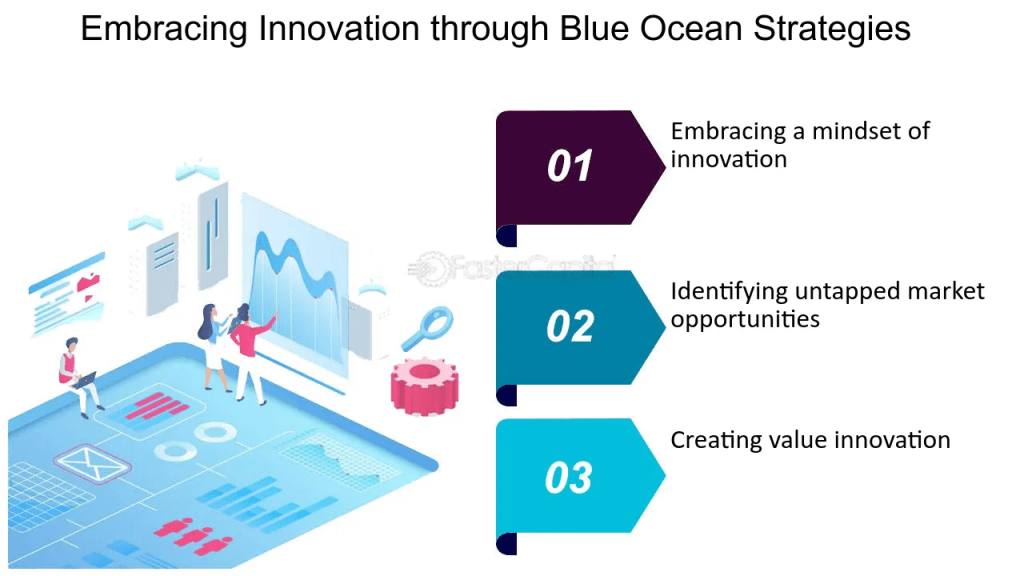
Photo By Faster Capital
Applying Blue Ocean Strategy in Healthcare
Case Study: MinuteClinic
MinuteClinic, a pioneer in retail-based healthcare, leveraged the Blue Ocean Strategy by offering convenient, affordable care for minor ailments in retail settings. This approach tapped into noncustomers who found traditional healthcare settings too costly or inconvenient. By reconstructing market boundaries and focusing on accessibility and affordability, MinuteClinic created a new market space with little competition.
Steps for Healthcare Entrepreneurs
1. Identify Pain Points: Conduct research to understand the pain points of potential noncustomers. This could involve surveys, focus groups, and analyzing current healthcare trends.
2. Innovate Value Propositions: Develop innovative solutions that address these pain points with compelling value propositions. For example, integrating AI into diagnostic tools to offer faster and more accurate results.
3. Strategic Partnerships: Form partnerships with technology firms, research institutions, or community organizations to enhance capabilities and reach.
4. Pilot and Scale: Test new offerings through pilot programs to gather data and refine the approach. Once validated, scale the operations to capture a broader market.
5. Continuous Evaluation: Regularly assess the market and adapt strategies to sustain competitive advantage and continue exploring new blue ocean opportunities.
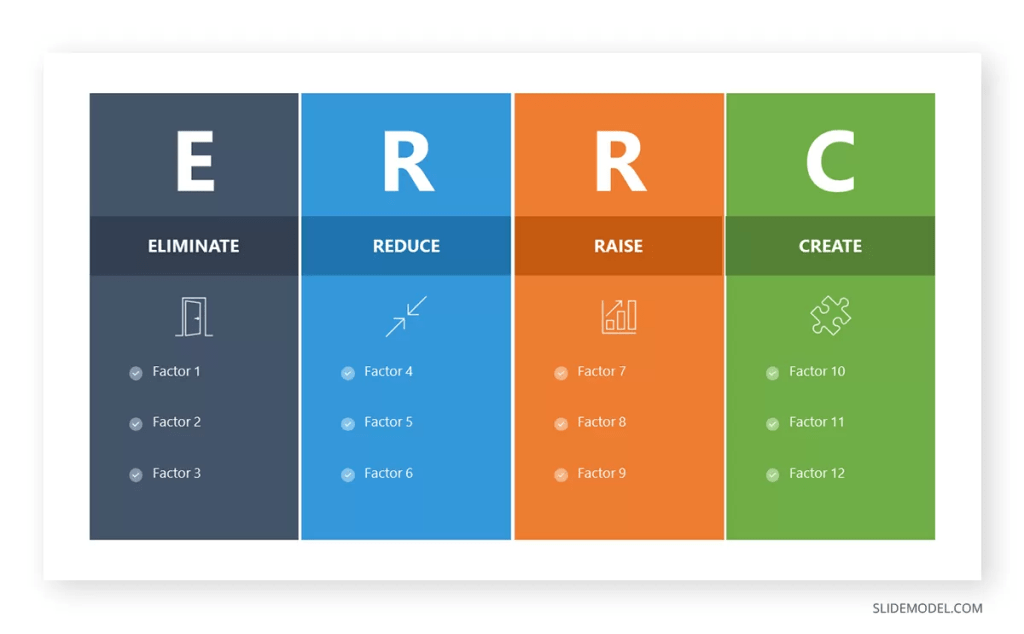
Photo By Slide Model
The Blue Ocean Strategy provides a framework for healthcare entrepreneurs to step out of competitive markets and venture into new territories of innovation and growth. By focusing on value innovation and strategic alignment, healthcare businesses can discover untapped potential and achieve sustainable success. Embracing this strategy requires a bold vision, a commitment to innovation, and the courage to navigate uncharted waters
Please leave your comments below

 Dr. Hamza Asumah
Leave a comment